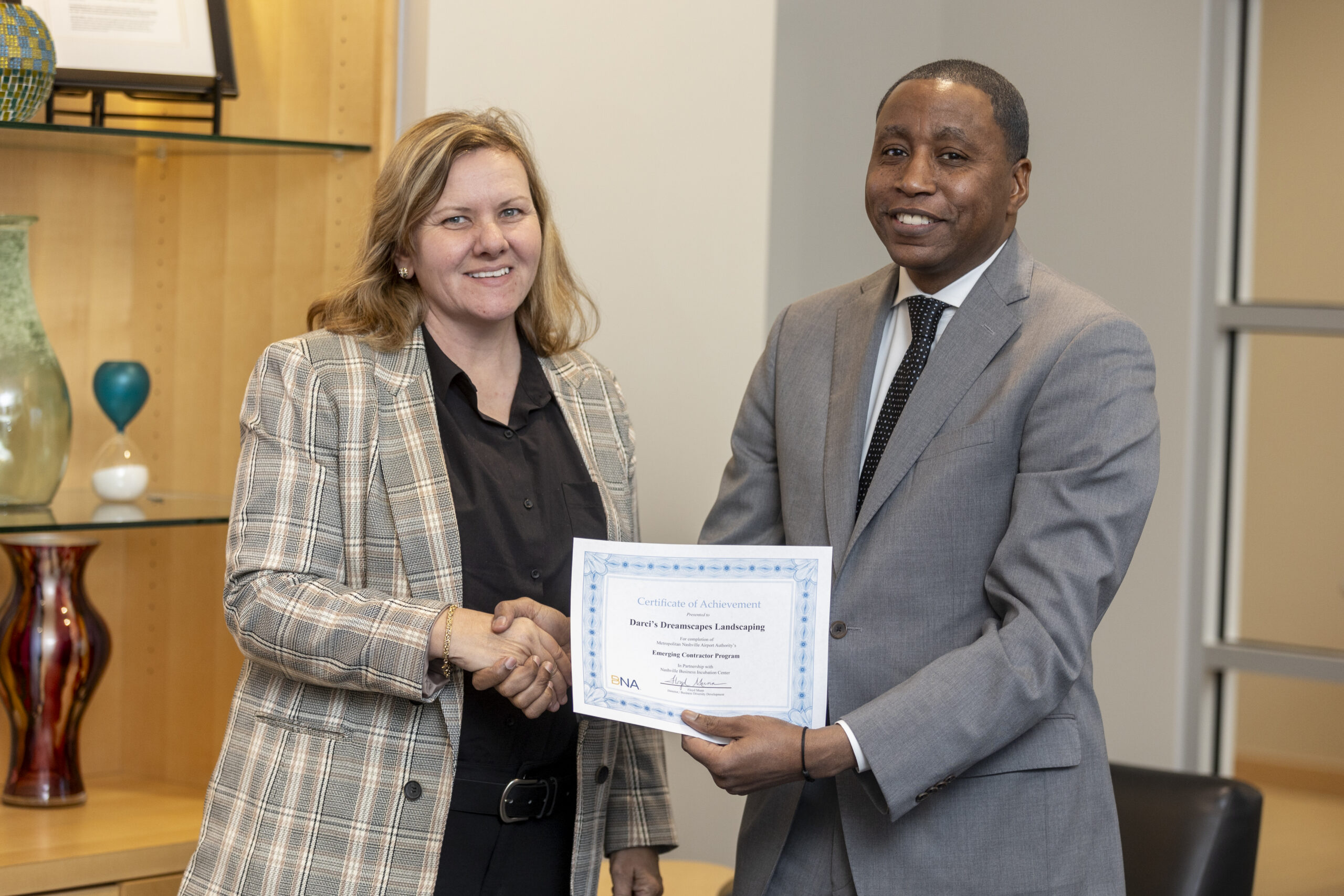
From Subcontractor to Prime Contractor: How Darci Gibbons Built a Business Ready for Bigger Opportunities with a $500K Increase

For more than 15 years, Darci Gibbons worked at Nashville International Airport on someone else’s contract.
Today she holds her own.
Darci is the owner of Dreamscape Landscape Services and a prime contractor at the airport where she spent more than a decade as a subcontractor. Her business has grown from seven contracts to eleven, expanded to five full-time employees, and increased annual revenue by more than $500,000.
Getting there almost didn’t happen. When NBIC offered her a seat in the upcoming class through a program funded through the Metropolitan Nashville Airport Authority (MNAA), she nearly turned it down.
“Honestly, I wasn’t sure if I was going to be able to complete it or finish it, or even want to, going back into schooling,” she says. “I was very scared about going to the class because of my technology and my computer skills and just getting set in a classroom environment again.”
She took the seat anyway.
Darci’s career began with a phone call in 2006. She was still in school. Her father owned a construction company, and a landscaping subcontractor had failed to show up for a commercial project near Opry Mills.
“He called me and said, ‘Do you want to come do my landscaping?’ And I was just like, ‘Okay.'”
She bought landscaping books and taught herself the trade. One project became many. Before long, Dreamscape Landscape Services was serving commercial clients across Middle Tennessee, and by 2008 Darci was subcontracting at the airport, work she would go on to do for more than 15 years.
She was good at it. She was also, without quite realizing it, stuck. The airport contracts she worked on belonged to someone else, and she had come to assume that was simply where she fit.
When MNAA’s Business Diversity Development Department introduced her to the program, Darci walked in expecting to brush up on a few things. What happened instead was harder but more useful.

“I wasn’t sure what the class entailed, and I actually fell in love with it. I fell in love with the other classmates, and I realized after I started taking the class that I really didn’t know anything about business, even being in it that long.”
It is one of the most honest things a business owner can say out loud, and it is usually the moment real growth begins. Darci had run a profitable company for nearly two decades. What she had not built was the infrastructure underneath it.
That support structure came in three pieces.
First, the numbers. Our MNAA program equipped Darci with the know how to start reading her business, watching costs, tracking profitability, and learning what each job actually earned.
“I learned to watch my spreadsheets and costs. I started making a lot more profits. I started looking for larger contracts. I’ve been awarded larger contracts.”
Second, the relationships. NBIC connected Darci with a banker and a bonding partner, the two relationships she now calls the most important in her business. Without bonding, a contractor cannot bid prime work at all. That single connection is the difference between watching an opportunity and competing for it.
Third, the technology she had spent years avoiding.
“I was really kind of old school. I didn’t have a lot of education in it. I was pretty terrible at it.”
With encouragement from NBIC, she learned Excel, expense tracking, scheduling, contract management, and how to answer a request for proposal (RFP). The skills mattered. What mattered more was that a woman who had been afraid of a classroom was now the person in the room who could build the bid.
Then the airport released it: the prime contract Darci had watched from the subcontractor’s side for more than a decade.
She was ready, and being ready was not an accident. She had earned her Tennessee General Contractor’s License, built out her financial statements, and put her bonding and banking relationships in place before she needed them. The preparation was already done when the opportunity arrived.
“If I had not taken that class, when the big bid that I was after for about 15 years came up, I would not have been able to transition right into being a prime contractor for such a large contract.”
She won it. When airport leadership later asked how the transition had gone, her answer surprised them.
“I said it was a breeze. I could easily bid on the RFP. I transitioned right into it. I could manage workers. It was so much smoother than it would have been three years prior.”
The results followed quickly. Dreamscape moved from seven active contracts to eleven and from three employees to five, adding more than $500,000 in annual revenue. Darci was no longer working on the contract. She was holding it.
Ask Darci what she is proudest of, and she does not reach the revenue figure.
“I actually have a business now that could be sold years to come, where before I had a business that if something happened to me or I needed to sell it, I wouldn’t be able to. Now because of this class, I’ve learned taxes, QuickBooks, and profits. At some point, I can possibly sell my business if I ever wanted to.”
That is the difference between owning a job and owning a business. Before the cohort, Dreamscape was Darci. Today it is a company with systems, records, and values that exist independently of the hours she works. She has built something that can outlast her involvement in it, which is the foundation of generational wealth for her family and stable employment for her crew.
Her Advice to the Next Darci
She knows exactly who is reading this, because she was that person three years ago: capable, experienced, and quietly convinced the classroom is not for her.
“I suggest any other contractors that are offered the opportunity to work with them just go headfirst into it and accept it. You will be very lucky to have that chance like I was because otherwise I wouldn’t be anywhere near where I am right now.”
She pauses, smiles, and sums up the whole experience in a way only someone who has lived it can.
“Kind of like [the program] said. You become a contractor.”
That is what the MNAA and NBIC partnership is built to do. Entrepreneurs arrive with skill and experience. They leave with the systems, relationships, and confidence to compete for work that once felt out of reach, and the communities around them gain stronger companies and better jobs.
“The main point is I went into a very large contract, and it went very, very smoothly because of this class. Years ago, it would not have happened. I’ve been very privileged to have taken this class, and I thank NBIC greatly for the opportunity.”
Ready to build or grow your business? Visit www.nbichub.org/bizquiz to take the BizQuiz to find the signature program suited for you.